As the 2026 market develops, Copper Braid Welding manufacturers face stricter demands for conductivity, flexibility, durability, and repeatable joint quality. Copper braids now support electric vehicles, battery systems, transformers, grounding assemblies, and industrial power equipment. A reliable manufacturer must control more than welding temperature. Material purity, braid structure, contact resistance, tensile strength, and inspection discipline also matter.
Professor Sindo Kou, a respected welding researcher, states, “Welding is a joining process in which two or more parts are united by means of heat or pressure or both.” This principle remains practical when evaluating copper braid suppliers. The best companies combine suitable welding methods with stable production records. They also provide traceable materials, clear testing data, and engineering support for difficult applications.
This article examines the leading Copper Braid Welding manufacturers expected to attract attention in 2026. The comparison considers manufacturing experience, equipment capability, customization, quality systems, delivery performance, and after-sales service. It will also distinguish established producers from companies with attractive marketing but limited technical evidence. That difference matters.
No ranking is permanent. Market claims can change quickly. Some manufacturers publish detailed specifications, while others reveal very little. Buyers should therefore verify certifications, sample performance, weld consistency, and real application references before making a decision. Even small variations in braid compression or weld width can affect electrical performance. The strongest suppliers understand this detail. The weaker ones may not.
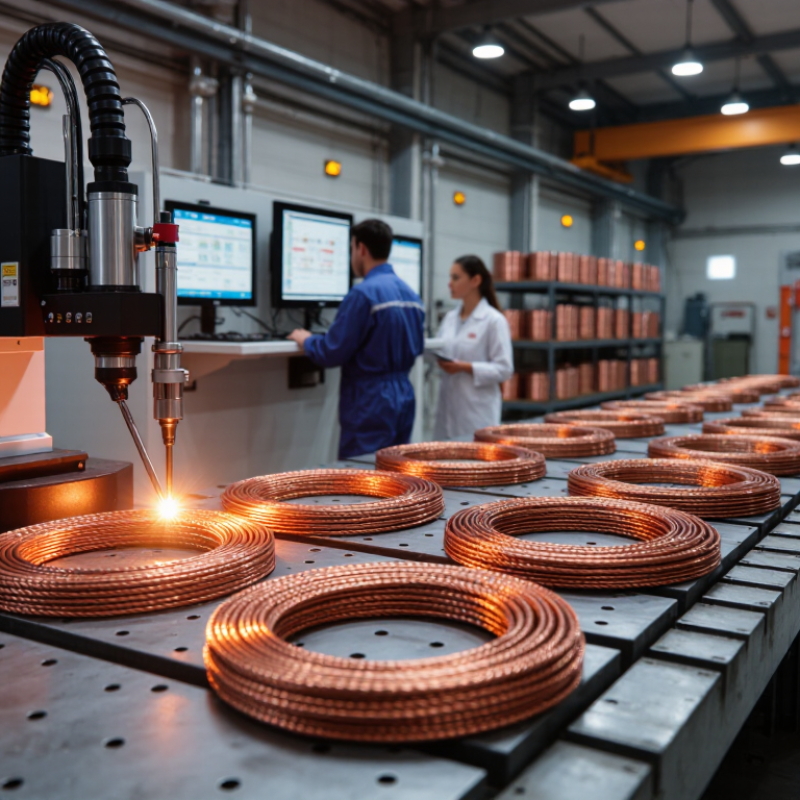
What Is Copper Braid Welding and Why Does Manufacturer Choice Matter?
Copper braid welding joins woven copper strands to terminals, busbars, or flexible connectors.
The process usually uses resistance, ultrasonic, or laser welding. It compresses many fine strands into a stable electrical and mechanical joint. It is not simply a shiny strap.
Copper offers excellent conductivity, but its heat transfer can complicate welding. Poor energy control may create weak bonding, strand damage, or excessive contact resistance. The IEA Global Critical Minerals Outlook 2024 projects copper demand rising from about 26 million tonnes in 2023 to 31 million tonnes by 2035. The USGS Mineral Commodity Summaries 2025 reports roughly 22 million tonnes of global mine production in 2024. These figures underline the need for efficient material use and repeatable joining quality.
Manufacturer choice matters because equipment quality affects weld force, current control, cooling, and inspection records. A practical supplier should provide peel or tensile results, resistance data, process windows, and traceability for copper grades. Ask how operators detect broken strands and inconsistent compression. A low resistance reading alone can mislead. In hands-on production, visual checks still catch useful clues, such as darkened edges or uneven braid width. Still, visual judgment is imperfect. Buyers should validate samples under vibration, thermal cycling, and repeated flexing before approving a 2026 supplier.
How Are the Top 2026 Copper Braid Welding Manufacturers Evaluated?
For 2026, top copper braid welding manufacturers should be evaluated through measurable production evidence. Inspectors usually check copper purity, braid flexibility, weld penetration, and electrical resistance. A reliable supplier provides batch records, material certificates, and traceable inspection data. Factory experience also matters. Teams with practical welding knowledge can adjust current, pressure, and cycle time for different braid sizes. Small errors can create hidden hot spots.
Tips: Request sample assemblies before placing a large order. Test them under vibration, bending, and repeated heating. Compare resistance readings before and after testing. Ask how rejected parts are recorded and corrected. A clean sample is useful, but it proves little alone. Production consistency matters more.
The strongest manufacturers combine process control with transparent customer support. Their equipment should maintain stable pressure and accurate weld energy. Their quality staff should understand metallurgical changes near the joint. Independent testing can confirm tensile strength and thermal performance. However, no scorecard is perfect. Some evaluation methods overlook long-term fatigue. Buyers should review field feedback, response times, and corrective-action reports. Clear drawings, realistic tolerances, and honest lead-time information also reveal professional maturity. A lower quoted price may hide weaker traceability or more manual rework.
Which Manufacturers Lead the 2026 Copper Braid Welding Market?
The 2026 copper braid welding market is led by manufacturers with stable resistance welding, precise tooling, and verified process control.
Public rankings remain limited for this specialized segment. However, the strongest suppliers usually serve automotive, battery, rail, and power-equipment applications.
The market pressure is real.
S&P Global projects copper demand could rise from about 28 million metric tons in 2021 to 42 million by 2040. This growth increases demand for flexible grounding straps, battery connections, and high-current joints.
Leading manufacturers respond with automated welding cells, laser measurement, and closed-loop current monitoring. They also control braid tension before welding. Small variations can create large resistance changes.
Testing separates capable producers from simple fabricators.
Experienced manufacturers report tensile strength, milliohm resistance, weld width, and thermal-cycle results. IEC and ASTM-based procedures improve comparability, although factory reports are not always equally transparent. That matters.
The International Energy Agency also identifies copper supply growth as a constraint for electrification projects. Manufacturers with traceable copper grades and repeatable weld records therefore gain buyer confidence.
Some suppliers still emphasize machine speed over long-term joint durability.
That is a weakness worth questioning. A reliable manufacturer should provide sample validation, cross-section analysis, and production data from similar braid sizes. Price alone can mislead.
In field applications, a poorly controlled weld may heat visibly before an inspection detects the problem.
What Technologies and Quality Standards Set Them Apart?
In 2026, leading copper braid welding manufacturers will be separated by process control, not impressive catalogs. The International Copper Study Group projected refined copper usage above 26 million tonnes in 2024, increasing pressure on material efficiency and supply reliability. Manufacturers now combine resistance, ultrasonic, and laser welding, depending on braid thickness, terminal design, and heat sensitivity. Resistance welding suits repeatable high-volume joints. Ultrasonic welding can reduce added material and limit heat-affected zones. Laser systems offer precise energy control, but they demand stricter surface preparation.
Quality evidence matters more than marketing claims. Reliable suppliers typically work under ISO 9001 systems and use calibrated testing aligned with ISO/IEC 17025 principles. For resistance welding, ISO 14554 provides a useful quality framework. Production records should identify copper grade, braid dimensions, weld force, current, cycle time, and operator or machine data. Pull testing, milliohm resistance checks, cross-section inspection, and thermal cycling reveal failures that visual checks miss. A bright weld is not automatically a strong weld.
The best factories also control oxidation, clamping pressure, and strand spread. They may use vision inspection and statistical process control to detect drift before rejection rates rise. Yet no certificate guarantees perfect performance. Copper surfaces vary, and small changes in plating thickness can alter weld behavior. Buyers should request recent test reports, sample traceability, and failure-analysis records. That extra review feels slow. It often prevents expensive field failures.
2026 Copper Braid Welding Manufacturers: Technology & Quality Reference Benchmarks
This chart summarizes measurable material and compliance benchmarks commonly used when evaluating copper braid welding suppliers. It shows standards-based reference values rather than company or brand performance data.
High-quality manufacturers typically document copper purity and conductivity, control resistance-welding or laser-welding parameters, and provide traceability and restricted-substance compliance. Copper content and conductivity are reference targets, while RoHS values are maximum permitted concentrations by weight.
How Should Buyers Compare and Select a 2026 Manufacturer?
What Are the 2026 Top Copper Braid Welding Manufacturers?
How should buyers compare and select a 2026 manufacturer? Start with repeatable welding performance, not attractive brochures. The International Copper Study Group projected refined copper usage growth of about 3.5% in 2025. This pressure makes material control increasingly important. Ask manufacturers for copper purity records, braid dimensions, weld resistance, and tensile-test results. Compare the same sample size under identical test conditions. A reliable supplier should explain its welding current, pressure, cycle time, and inspection frequency.
Production evidence matters more than confident promises. Request recent batch reports and traceability from copper wire to finished joint. Check flatness, exposed strands, discoloration, burrs, and heat-affected areas. For high-current applications, measure milliohm resistance after repeated flexing and thermal cycling. ISO 9001 certification can support process discipline, but it does not prove braid quality. A polished certificate is not enough. I would still question suppliers that avoid independent testing.
Tips:
Send a detailed drawing and acceptance limits before requesting quotations. Compare warranty terms, sampling plans, delivery capacity, and corrective-action speed. Review at least three production samples, not one perfect piece. The IEA’s Global Critical Minerals Outlook 2024 also identifies copper supply growth as a strategic concern through 2035. Therefore, buyers should examine recycled-content controls and long-term raw-material planning. These details often reveal whether a 2026 manufacturer can support stable production, rather than merely win an initial order.
Conclusion
Copper Braid Welding is a specialized joining process used to create reliable electrical and mechanical connections in applications that require flexibility, conductivity, and resistance to vibration. In 2026, choosing the right manufacturer matters because product consistency, welding precision, material quality, production capacity, and technical support can directly affect safety, service life, and overall project efficiency. Leading manufacturers are expected to demonstrate strong process control, stable performance, and the ability to produce customized braid assemblies for different industries and operating conditions.
The top 2026 manufacturers can be evaluated through their welding technologies, quality inspection systems, certification practices, delivery reliability, customization capabilities, and after-sales service. Buyers should compare conductor materials, braid structure, joint strength, dimensional accuracy, testing procedures, and total cost rather than focusing only on the initial price. A careful supplier assessment, supported by samples, technical documentation, and clear communication, can help purchasers select a dependable Copper Braid Welding partner that meets both current requirements and future production needs.

 Xingma