Choosing among the 7 Best Copper Strip Welding Machines for Global Buyers requires more than comparing prices and power ratings. Copper Strip Welding demands controlled heat, stable pressure, and accurate strip alignment. A reliable machine should create clean joints without excessive discoloration, distortion, or material waste. Buyers also need to examine welding thickness, cycle time, electrode design, cooling performance, and compatible copper grades.
This guide evaluates seven machines from a practical purchasing perspective. It considers production capacity, operating consistency, maintenance access, safety features, and supplier support. A compact workshop machine may suit battery tabs or small electrical components. A heavier industrial model may perform better during continuous production. Details matter.
Real factory conditions can expose weaknesses that brochures hide. Operators should inspect sample welds, ask for test data, and confirm spare-part availability before ordering. Voltage compatibility, installation requirements, training, and after-sales response also affect the final cost. These points are easy to overlook.
No shortlist is perfect. A machine praised by one manufacturer may disappoint another because materials, workloads, and quality targets differ. Buyers should treat specifications as starting evidence, not final proof. Independent testing remains valuable, especially when welding thin copper strips at high speed. The following selection highlights machines that balance performance, usability, reliability, and long-term value for international buyers. Some options may appear expensive initially, yet stable weld quality can reduce rejected parts and unexpected downtime. That benefit should be measured, not assumed.
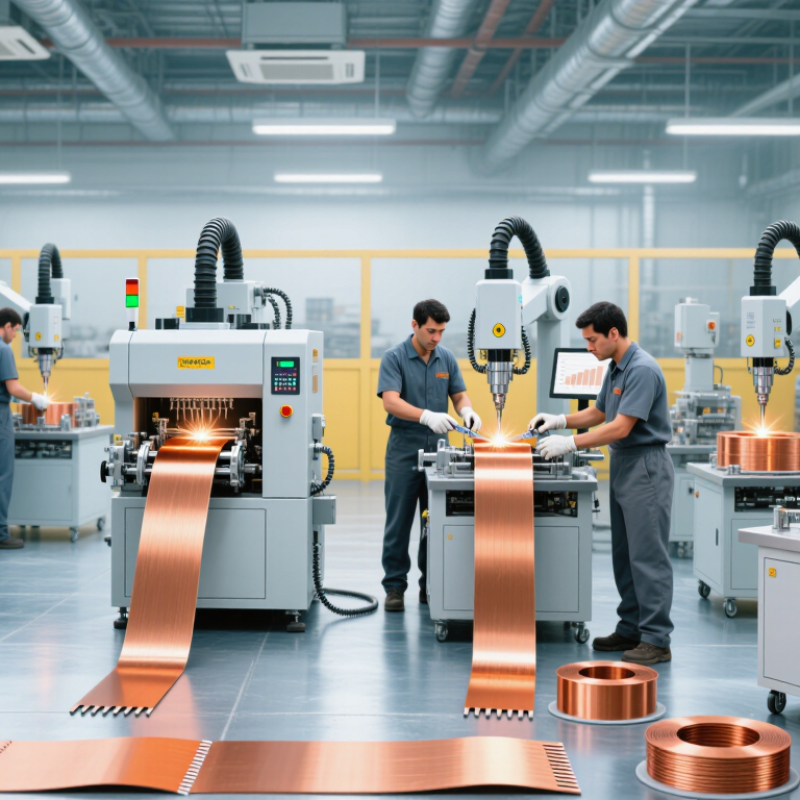
Copper strip welding machines join thin copper conductors with controlled heat, pressure, vibration, or light. Their main functions include forming stable joints, limiting oxidation, and maintaining repeatable electrical resistance. Resistance welding uses current between electrodes, while ultrasonic welding creates a solid-state bond with minimal melting. Laser welding can produce narrow, precise seams, but reflective copper requires careful energy control.
These machines support battery tab assembly, solar ribbon production, transformer windings, busbar connections, and electrical component manufacturing. Useful systems offer adjustable welding current, electrode force, pulse duration, cooling, and real-time monitoring. Vision alignment helps position narrow strips accurately. Data logging also supports traceability during quality checks.
Small details matter.
Global buyers should compare strip thickness, width, surface coating, conductivity, and required production speed. A machine that handles thick copper may damage delicate foil. Test samples should include resistance checks, pull tests, and visual inspection under magnification. A polished sample can mislead. I would not approve equipment from one trial alone. Operators should also inspect electrode wear, calibration stability, cooling performance, and replacement-part access. Copper reflects laser energy strongly, and ultrasonic tools may need frequent adjustment. The most reliable choice is not always the fastest machine; it is the system that maintains consistent joints during long production runs.
Choosing among seven copper strip welding machines requires more than comparing advertised power. Begin with weld consistency. A stable current source should produce clean joints across repeated cycles. Watch the strip edge, not only the control screen. Excessive heat can discolor copper and weaken nearby insulation.
Check compatibility with your actual strip thickness, width, and alloy. Pulse duration, pressure control, and electrode alignment matter greatly. A machine that handles thin copper may struggle with wider strips. Ask for sample welds using your material. Small details matter. Examine the joint under magnification. Look for cracks, uneven marks, or excessive deformation.
Cooling design is another practical test. During a long production run, poor heat control can change weld quality within minutes. Review temperature monitoring, emergency stops, guarding, and applicable electrical certifications for your market. Reliable documentation supports safer installation and easier audits. Maintenance access also deserves attention. Replaceable electrodes, clear calibration procedures, and available spare parts can reduce downtime.
I prefer machines with measurable data logs. They help operators trace defects instead of guessing. However, automation is not always better. Complex software can slow a small workshop when training is limited. Total cost should include tooling, energy, servicing, installation, and operator instruction. A low purchase price may become expensive later. I have seen promising specifications fail during practical trials. Leave room for testing, adjustment, and honest review before making the final decision.
Precision copper strip welding depends on heat control, alignment, and repeatable pressure. Three machine types deserve attention from global buyers: laser welders, micro-resistance welders, and ultrasonic metal welders. Each solves a different production problem.
Laser welding machines create narrow seams with limited distortion. A green laser source can couple with reflective copper more efficiently than a standard infrared beam. This matters when strips are thin, bright, and closely spaced. Operators should check spot size, pulse stability, shielding gas, and camera alignment. A seam viewed at 20x magnification should show smooth edges, not scattered pores. Laser systems suit battery tabs, electrical contacts, and compact assemblies. They also demand careful setup. Small focus errors can weaken the joint.
Micro-resistance welders use controlled current, electrode force, and short welding times. They work well for repeatable strip joints and high-volume electrical parts. Copper rapidly carries heat away, so programmable current ramps are valuable. Water-cooled electrodes help maintain consistency during long shifts. Ultrasonic welders join copper through vibration and pressure, often without added filler. They can reduce thermal damage near sensitive components. However, surface condition and clamping pressure strongly affect results.
No machine is perfect. A fast cycle may hide inconsistent contact. In practical trials, buyers should test real strip thicknesses, widths, coatings, and production speeds. Record pull strength, electrical resistance, weld appearance, and electrode wear. One overlooked detail can matter: clean copper does not always mean weld-ready copper. Proper fixturing, calibrated sensors, operator training, and documented inspection make the equipment more reliable.
Independent comparison based on commonly specified industrial configurations for copper strip joining, battery interconnects, electrical conductors, and precision metal assembly.
| Rank | Machine Configuration | Welding Technology | Typical Copper Strip Range | Maximum Strip Width | Typical Output / Cycle | Electrical Supply | Primary Strength | Best-Fit Applications | Important Buying Consideration |
|---|---|---|---|---|---|---|---|---|---|
| 1 |
Precision Fiber-Laser Strip Welder
Leading Precision Choice |
Continuous-wave or pulsed fiber laser with vision alignment | 0.05–1.50 mm thickness | Up to 100 mm | Approximately 20–120 welds/min, depending on joint design | Three-phase, 380–480 V; typically 3–10 kW installed power | Small heat-affected zone, high repeatability, and non-contact welding | Battery tabs, copper foil joints, busbars, fine electrical strips, and sealed assemblies | Requires accurate fixturing, fume extraction, optical protection, and suitable laser safety controls |
| 2 |
Servo-Controlled Resistance Strip Welder
Leading Production Choice |
Projection, butt, or overlap resistance welding with programmable servo force | 0.10–3.00 mm thickness | Up to 150 mm | Approximately 10–60 welds/min, depending on weld area and cooling time | Three-phase, 380–480 V; transformer ratings commonly 25–100 kVA | Fast cycle times, strong joints, and excellent suitability for automated lines | Busbars, cable terminals, battery connectors, electrical contacts, and copper strip assemblies | Electrode material, electrode force, current waveform, and water cooling strongly affect tool life |
| 3 |
Ultrasonic Metal Strip Welder
Leading Low-Heat Choice |
High-frequency ultrasonic solid-state welding | 0.02–1.00 mm thickness per strip, subject to material stack-up | Typically up to 40 mm | Approximately 20–100 welds/min | Single-phase, 200–240 V or 380–480 V; commonly 2–8 kW | Very low bulk heating and clean solid-state bonding without filler metal | Battery foil stacks, laminated copper conductors, wire-to-strip joints, and compact electronics | Weld width is limited by sonotrode size; tooling must match strip thickness and surface condition |
| 4 | Capacitive-Discharge Resistance Welder | Short-duration capacitor-discharge resistance welding | 0.05–1.50 mm thickness | Up to 80 mm | Approximately 15–80 welds/min | Single-phase, 200–240 V; typically 1–5 kW input | Very short current pulses with reduced thermal distortion | Thin copper tabs, small terminals, contact strips, and electronic components | Stored-energy capacity and electrode geometry must be selected for the required weld nugget size |
| 5 | Copper Strip Butt-Welding Line | Flash-butt or upset-butt resistance welding with automatic strip feeding | 0.30–6.00 mm thickness | Up to 200 mm | Approximately 4–20 joints/min | Three-phase, 380–480 V; commonly 50–200 kVA transformer capacity | Continuous joining of coils or long strip sections with high mechanical strength | Transformer strip, electrical conductor production, grounding components, and coil processing | Needs robust end preparation, precise strip alignment, upset control, and post-weld trimming |
| 6 | Micro-TIG Copper Strip Welder | Precision pulsed TIG welding with inert-gas shielding | 0.10–2.50 mm thickness | Up to 100 mm | Approximately 3–20 welds/min | Single-phase, 200–240 V; typically 2–8 kW | Flexible process control for prototypes, repairs, and complex joint geometries | Low-volume production, custom busbars, repair work, and thick copper strip joints | Slower than resistance or laser welding and requires gas management plus skilled parameter setup |
| 7 | Manual Pneumatic Resistance Strip Welder | AC or medium-frequency resistance welding with pneumatic electrode actuation | 0.20–2.00 mm thickness | Up to 100 mm | Approximately 5–30 welds/min | Single-phase, 200–240 V or three-phase, 380–480 V; commonly 10–60 kVA | Cost-effective operation, simple maintenance, and flexible low-volume production | Electrical panels, copper connectors, maintenance workshops, and job-shop fabrication | Manual loading affects consistency; use force monitoring and current control for repeatable results |
Specification ranges are typical industry reference values rather than guaranteed ratings. Final performance depends on copper grade, strip thickness and width, joint overlap, surface condition, electrode or tooling design, cooling capacity, and automation level.
7 Best Copper Strip Welding Machines for Global Buyers
Four Reliable Machines for High-Volume Industrial Production
High-volume copper strip production demands stable joints, fast cycling, and controlled heat input. Four machine types deserve close attention.
An automated resistance butt welder suits repetitive strip joining. It uses pressure and electrical current to create compact joints. Modern systems can monitor weld force, current, and cooling time. Operators should inspect electrode wear every shift. Small alignment errors can cause uneven edges.
A flash butt welder handles thicker copper strips and demanding production schedules. It removes surface impurities before forging the heated ends together. This process can produce strong joints with limited filler material. However, flash control needs careful adjustment. Excessive heat may distort the strip.
A laser welding machine offers narrow welds and low mechanical deformation. It works well where clean surfaces and accurate positioning are available. A green-wavelength laser can improve copper energy absorption. Safety enclosures and trained operators remain essential. The equipment is precise, but not forgiving.
An ultrasonic metal welder joins copper strips through vibration and pressure. It requires no melting in many applications, reducing thermal damage. This option fits thin strips, battery components, and sensitive assemblies. The joint area must remain clean and correctly clamped. Production teams sometimes underestimate fixture design.
Reliable output depends on more than the machine itself. Record weld current, force, temperature, and joint resistance. A common mistake is trusting speed before validating consistency. Pilot runs may reveal unexpected burrs or unstable contact. That inconvenience is useful. It exposes weaknesses before full production begins.
Four reliable machine configurations for high-volume industrial production
The comparison highlights common production specifications for industrial copper strip welding equipment. Continuous laser systems generally provide the highest line speed, while resistance and butt-welding systems are widely selected for heavier strip sections and demanding duty cycles. Actual performance depends on copper grade, strip thickness, joint design, cooling capacity, and automation level.
Choosing among the seven best copper strip welding machines requires more than comparing output power. Certifications should match the destination market and the exact machine model. Check certificate numbers, issuing bodies, test scope, and expiry dates. A factory certificate alone may not prove product compliance. Ask for electrical diagrams, safety records, and recent inspection reports. Details matter.
Support often determines whether production continues after installation. Confirm response times, service languages, training options, and spare-part availability before payment. Ask whether technicians can diagnose unstable welds remotely. During testing, record strip thickness, weld pressure, current settings, and cooling temperature. Small records prevent large arguments. However, promised support may look better than actual support. Request references from comparable overseas users, if available.
Total cost of ownership includes much more than the purchase price. Include shipping, installation, import charges, power consumption, cooling water, electrodes, tooling, software, and operator training. Estimate maintenance by production volume, not by brochure claims. A machine that costs less may create expensive downtime when a replacement part takes six weeks. I have seen buyers overlook compatible tooling and lose production during the first month. That mistake is avoidable, but not always. Compare warranty limits, consumable life, upgrade costs, and local service coverage in one spreadsheet. Even then, the spreadsheet can miss lost revenue from inconsistent weld quality.
Compare weld consistency across repeated cycles, not advertised power alone. Watch the strip edge for discoloration, uneven marks, or deformation. The control screen proves little. Stable current and pressure are essential.
Check your strip thickness, width, and alloy against the machine’s working range. Request sample welds using your actual material. Inspect each joint under magnification for cracks or weak edges. Do not guess.
Pulse duration controls heat entering the joint. Poor alignment can create uneven contact and damaged edges. Pressure must remain stable during every cycle. Small shifts matter.
An automated resistance butt welder suits repetitive joining with controlled pressure and current. It can monitor weld force, cooling time, and electrical input. Operators should inspect electrode wear every shift. A tiny alignment error can spread through production.
Flash butt welding suits thicker strips and demanding production schedules. It removes surface impurities before pressing heated ends together. Careful flash control prevents distortion and excessive heat. The process is strong, but adjustment takes attention.
Laser welding creates narrow joints with limited mechanical deformation. It requires clean surfaces, accurate positioning, guarding, and trained operators. Ultrasonic welding suits thin strips and heat-sensitive assemblies. Fixture design is easy to underestimate.
Review temperature monitoring, emergency stops, guarding, and market-specific electrical certifications. Poor cooling can change weld quality within minutes during long runs. Check whether operators can access maintenance areas safely. Heat quietly changes results.
Include tooling, energy, installation, servicing, spare parts, and operator training. A low purchase price may become expensive later. Data logs can record current, force, temperature, and joint resistance. Speed can mislead. Pilot runs may reveal burrs or unstable contact.
This guide to the 7 Best Copper Strip Welding Machines for Global Buyers explains how Copper Strip Welding supports the production of batteries, electrical components, power systems, and other precision assemblies. It introduces the main functions, applications, and core technologies used to create stable, conductive, and durable welds. Buyers will also learn how to compare machines by welding accuracy, strip thickness range, production speed, automation, energy efficiency, ease of operation, and maintenance requirements.
The guide presents three machine categories suited to precision welding and four reliable options designed for high-volume industrial production, without focusing on any specific brand. It also highlights essential global buying factors, including safety and quality certifications, supplier support, spare-parts availability, operator training, warranty terms, and total cost of ownership. By considering both technical performance and long-term operating value, international buyers can select a machine that matches their materials, production goals, compliance needs, and budget.

Xingma